Poly B pipe identification chart
Six pipe materials turn up in Canadian homes, and three of them get mistaken for Poly B again and again. This is the side-by-side chart: colour, print string, fittings, era and verdict, so you can settle it standing in your own basement.
The 30-second answer
Read the pipe, not the colour. Every plastic supply pipe carries a printed line of text along its wall called a print string. If it contains PB2110 or CSA-B137.8, it is Poly B. Nothing else in the chart below carries those two markings, and grey colour on its own proves nothing in either direction.
The master chart
Scan the print-string column first. It is the only column in this table that gives a definitive answer. Everything else narrows the field.
| Pipe | Typical colour | Print string | Joints and fittings | Canadian era | What it means |
|---|---|---|---|---|---|
| Poly B | Grey, most often. Sometimes blue, black or silver | PB2110, CSA-B137.8 | Insert fitting with a crimped metal ring, usually copper-coloured | Roughly 1978 to 1998 | The pipe this library is about. Degrades from the inside; no longer an accepted material |
| PEX | Red, blue or white. Some PEX is grey | CSA B137.5, plus a CL1 to CL5 rating | Crimp rings, usually black, or expansion rings. Not interchangeable with Poly B rings | Late 1990s to today | A modern replacement pipe. Different plastic, no Poly B chlorine problem |
| PE-RT | Usually white or light | CSA B137.18, plus a CL rating | Crimp or expansion, same modern families as PEX | Added to the National Plumbing Code in 2020 | The material our own crews install. The newest of the accepted options |
| Kitec | Orange and blue pairs are the signature | The Kitec brand name in the print string | Brass compression fittings | Later era than Poly B | A different problem entirely: plastic-aluminum composite with its own separate class action. Frequently confused with Poly B and shouldn’t be |
| Copper | Metallic, dulling to brown or green | None. Metal, rigid, not printed | Soldered joints with sharp elbows, never crimped plastic | Throughout | Not plastic, not Poly B. Nothing to investigate |
| ABS / PVC drain | Black or white, and much fatter | ABS or PVC drain standards | Glued hubs, rigid | Throughout | Waste pipe, not supply pipe. Poly B was only ever a supply pipe |
The print string decoder
The print string is a line of text repeated along the pipe wall every foot or two. On a grey pipe it is usually printed in darker ink and can be faint under dust. Wipe a section with a damp cloth and read along the length, not across it.
| What you read | What it tells you |
|---|---|
| PB2110 | The polybutylene resin designation. This is the definitive identification. If you find it, you have Poly B and no second opinion is needed |
| CSA-B137.8 | The withdrawn Canadian standard polybutylene was certified to. Seeing it in a print string also means Poly B |
| CSA B137.5 | PEX. A modern accepted pipe, not Poly B, even if the pipe happens to be grey |
| CSA B137.18 | PE-RT. Also modern and accepted |
| CL1 through CL5 | A chlorine-resistance rating, tested under ASTM F2023. Poly B has no such rating; the test exists because of what happened to Poly B |
| Nothing legible | Common. Stamps fade, get painted over, or face the wall. Fall back on colour, fittings and build year together, and treat the pipe as Poly B until a plumber confirms otherwise |
The colour chart, and why it never settles it
Grey is the colour most Canadians associate with Poly B, and it is the most common, but the association cuts both ways. Poly B was also produced in other colours, and some modern PEX is grey. Use colour to decide where to look harder, never to reach a verdict.
- ✓Grey. The classic. Most Canadian Poly B installs
- ✓Blue. Less common, and the colour also used for cold-water PEX, so this one genuinely needs the print string
- ✓Black. Less common indoors. Buried polybutylene service lines from the 1970s and 80s are a separate story covered on the service line page
- ✓Silver or cream. Uncommon, and easy to mistake for a modern pipe at a glance
The fittings chart
Fittings matter twice over. They tell you what pipe you are looking at, and in a Poly B system they are also the part most likely to fail first. Which kind you have is largely a question of which province the house is in.
AB · Copper and brass inserts
The Alberta norm, and the better outcome. A metal insert fitting inside the pipe with a copper-coloured crimp ring squeezed around the outside. Alberta’s regulator counted only a handful of failures over twenty years, all tied to improper installation.2
BC · Grey and white acetal
Plastic insert fittings, more common in BC installs, and the component with the worst failure record anywhere. Chlorine embrittles them. Combined with more chlorinated water treatment, BC systems carry the higher risk profile.3
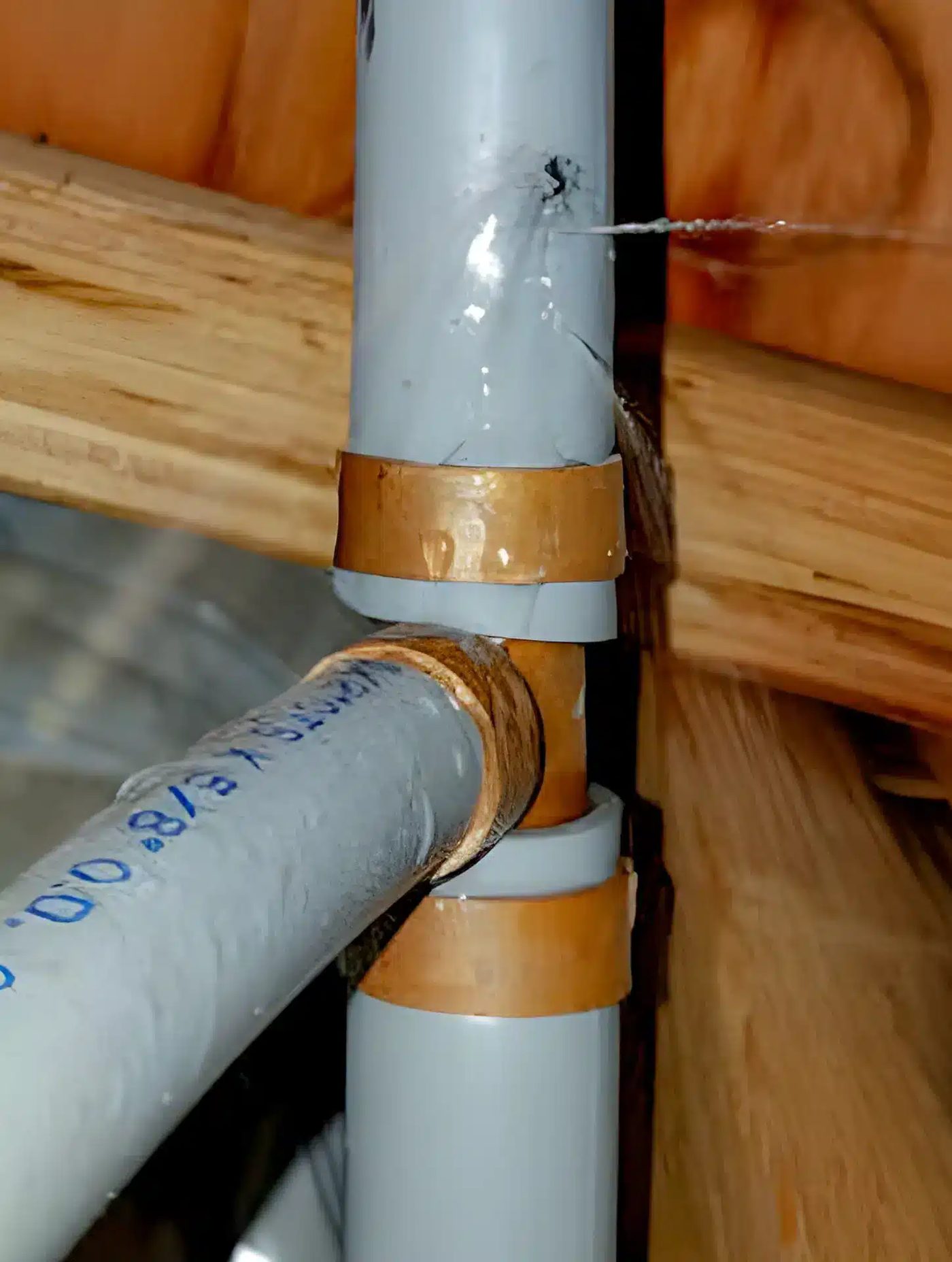
One detail that separates Poly B from PEX quickly at the joint: Poly B crimp rings are usually copper-coloured, PEX crimp rings are usually black, and the two are not interchangeable. If someone has spliced PEX fittings onto Poly B, that is its own problem, and the fittings guide covers what is actually certified for the job.
What it actually looks like
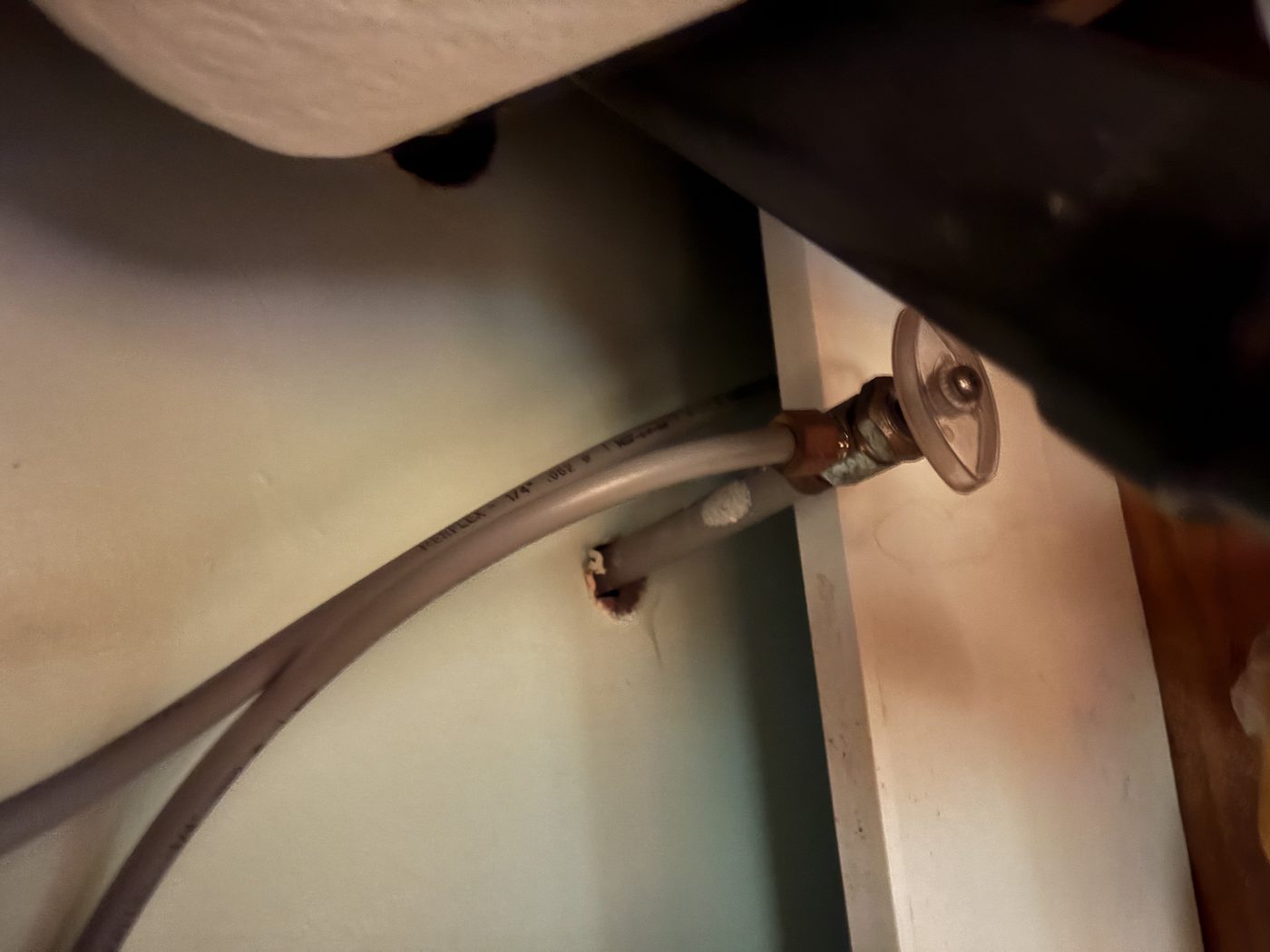
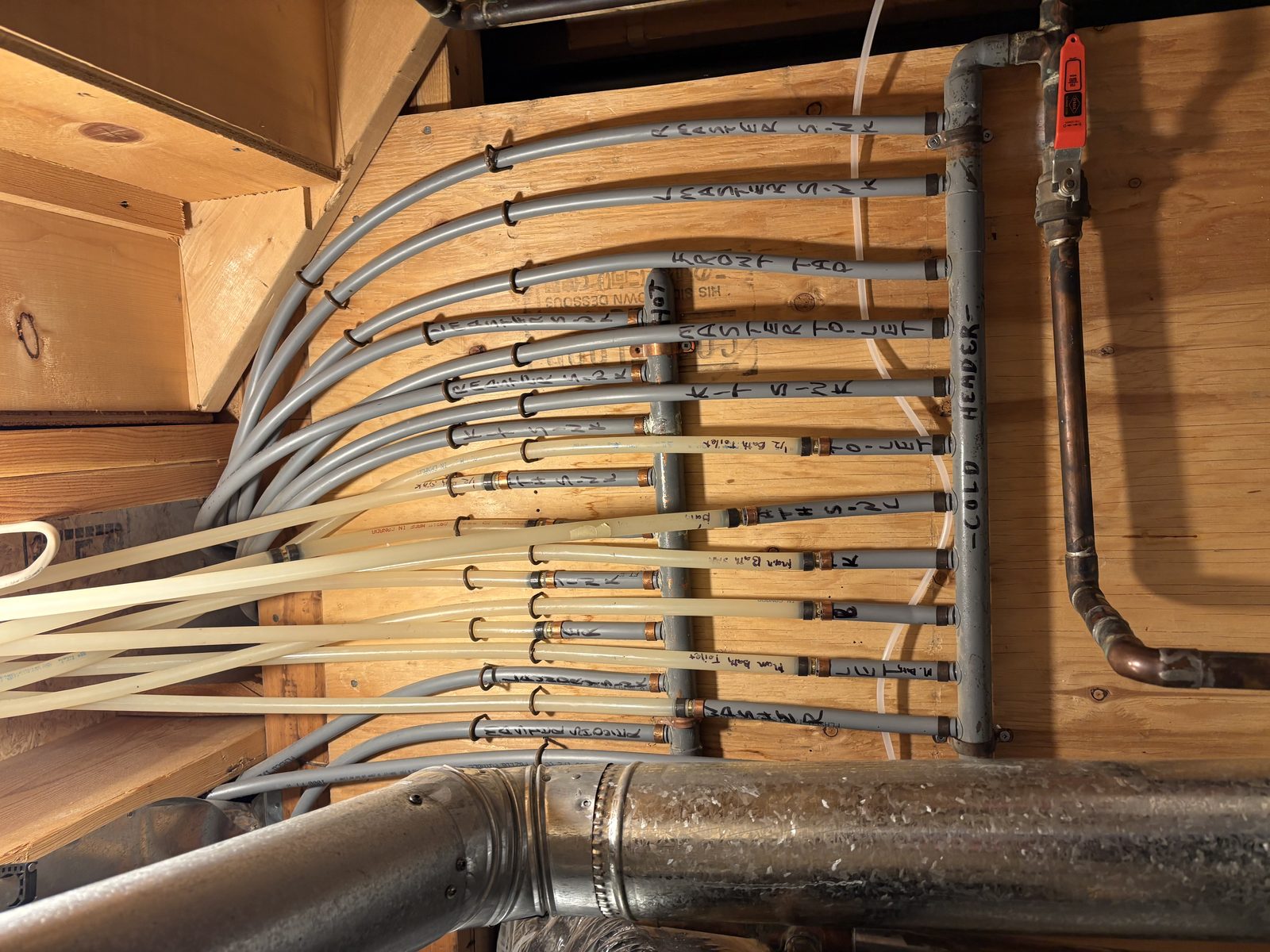
Every photograph below is from our own job records, in real Canadian homes, not a catalogue.

Where to look, in order
Four spots settle almost every house, and none of them need tools. The water heater first, then under the kitchen sink, then the basement ceiling, then the main shutoff. The full visual guide has an interactive cutaway for each one, along with the ten-minute walkthrough.
If you want the likelihood before you go looking, the address checker maps construction eras neighbourhood by neighbourhood across 31 Canadian cities, and by census build-era data everywhere else.
Common questions
Is all grey plastic pipe Poly B?
No. Some modern PEX is manufactured in grey, and a grey pipe installed in 2015 is not Poly B no matter how much it looks the part. The reverse is also true: Poly B was made in blue, black and silver as well. Colour tells you where to look; the print string tells you what you have.
My pipe is grey and flexible but I cannot find any printing at all.
Very common. Print strings fade with age, get painted during renovations, or simply face the joist. Use the other three signals together: a home built or replumbed between 1978 and 1998, flexible plastic with gentle curves rather than sharp soldered elbows, and crimped metal rings at the joints. If all three line up, treat it as Poly B until a plumber says otherwise.
Is Poly B the same as Kitec?
No, and conflating them muddies both stories. Kitec is a plastic-aluminum composite from a later era with its own separate class action, and it usually appears as orange and blue pipe with brass fittings. The full answer covers the difference.
Does finding Poly B mean I have to replace it?
Not by law. Codes are not retroactive and existing Poly B is legal to keep. The codes chapter covers that, and the insurance chapter covers the pressure that actually sets most people’s timeline.
Sources for this page
- Square One Insurance, Poly B plumbing guidance
- Alberta Municipal Affairs, Polybutylene (Poly-B) fact sheet
- Canadian home inspection industry knowledge bases
- National Plumbing Code of Canada, 2005 and 2020 revisions (NRC-CNRC)
- CSA B137 series pipe standards, and ASTM F2023 chlorine resistance testing
- Poly B Plumbing Guys job records, for every photograph on this page
Facts on this page are drawn from the government, insurer, and industry documents named above and rewritten for clarity. Definitions for every term used here are collected in the glossary.
Cette page existe aussi en français : comment identifier la tuyauterie Poly B.

Published by Poly B Plumbing Guys
This library is maintained by the team that replaces Poly B every day across Alberta and BC. Red Seal certified plumbers, full remove-replace-restore service including drywall and paint, a 25-year warranty, and the completion certificate insurers ask for.
Get your pipes checked →